
Experimental Fluid Mechanics · Tel Aviv University
Understanding turbulent flows, one small scale at a time.
The Turbulence Structure Laboratory develops and applies three-dimensional particle tracking velocimetry, Lagrangian flow analysis, and physics-informed machine learning to understand how turbulent flows organize, mix, and transport energy — from stratified natural flows to real-time experimental diagnostics. We also develop novel microscopic flow sensors using MEMS technology, extending our measurements down to the smallest scales.
About the lab
Measuring flows to understand how they work
To understand a turbulent flow, you have to measure it. Our lab develops and applies quantitative flow-diagnostic techniques — including particle image velocimetry (PIV) and three-dimensional particle tracking velocimetry (3D-PTV) — to resolve the dynamics and structure of turbulent flows, fluid–structure interactions, complex fluid behavior, and the stresses flows exert on objects and surfaces.
We are committed to advancing fluid mechanics through experimental research and open science — building a collaborative environment where advanced technology and interdisciplinary approaches drive turbulence studies, sharing our discoveries with the global scientific community, and training the next generation of engineers.
We combine multi-camera imaging, custom reconstruction algorithms, and — increasingly — physics-informed machine learning to push these measurements toward real time, and we maintain OpenPIV and OpenPTV, open-source tools used by the experimental fluid mechanics community worldwide.
- Focus
- 3D particle tracking velocimetry & Lagrangian turbulence
- Also studied
- Density-stratified flows & physics-informed ML
- Open source
- Key maintainer of OpenPIV and OpenPTV
- Institution
- School of Mechanical Engineering, Tel Aviv University
Research & projects
Selected work

Three-Dimensional Particle Tracking Velocimetry
We develop 3D-PTV for many years. Standing on the shoulders of giants, we extended the original design from ETH Zurich into a real-time…
Read more →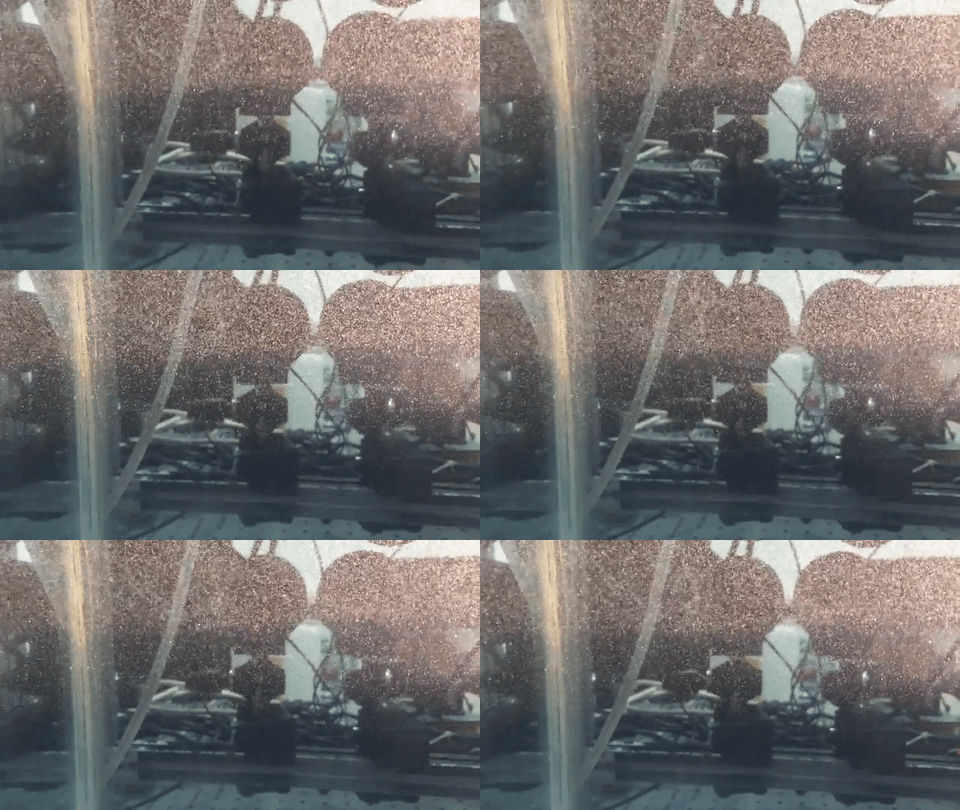
Turbulence in Stratified Fluids
Stratification, the layering of fluid by density, affects turbulence in several ways and on multiple scales. Every fluid element wants to return to…
Read more →
Turbulent Canopy Flows
Together with the Israel Institute for Biological Research (IIBR), the lab studies turbulence structure inside and above the canopy layer, aiming to…
Read more →Lab news
Latest updates
Omer Hadar Presents Left-Ventricular Flow Work at ISBME
Omer Hadar presented the lab's left-ventricular flow work at the Israel Society for Biomedical Engineering's annual conference. Omer Hadar, M.Sc. student in the Turbulence Structure Laboratory, presented a poster at the Israel Society for Biomedical Engineering annual conference: “Experimental Quantification of Three-Dimensional, Time-Resolved Fluid–Structure Interaction in a Left-Ventricular Phantom,” co-authored with Noaz Meivar, Shai Avidan, and Alex Liberzon. The work reconstructs 3D...
Read post →Eytan Stibbe, the Rakia Mission, and a liquid lens
At a Rakia Mission meeting on space industry-academia collaboration, a conversation with Eytan Stibbe turned to a well-known photograph from the International Space Station. Alex Liberzon took part in a meeting on a roadmap for collaboration between the space industry and academia, organized by the Israel Space Forum together with the Rakia Mission and the Israel Space Agency. There he met Eytan Stibbe. The conversation turned to the well-known photograph of Eytan looking into the camera...
Read post →OpenPIV Makes the Slide at a Phantom High-Speed Camera Webinar
A post-processing slide from a Phantom high-speed camera webinar lists OpenPIV right next to LaVision and Dantec — a small, useful data point on who actually uses it. Phantom, the Vision Research high-speed camera line used across many PIV and 3D-PTV labs (including ours), ran a webinar on flow-field post-processing. One slide splits the field into two columns: an open-source column listing OpenPIV, PIVlab, and others, next to a commercial column listing LaVision and Dantec. The open-source...
Read post →Interested in collaborating?
We welcome inquiries from prospective students, collaborators, and colleagues working on experimental fluid mechanics, flow diagnostics, or physics-informed machine learning.